Google Ads for Affiliate Marketing: 6 Costly Mistakes to Avoid
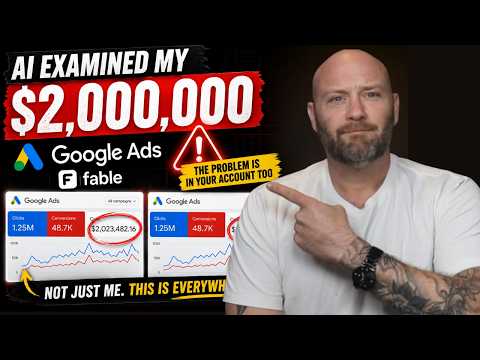
I've spent over $6 million on Google Ads as an affiliate, and one of my campaigns has done more than $2 million in commissions over the years. I recently exported years of that data and gave it to Claude's newest reasoning model, Fable, with one instruction: forget the Google Ads checklist and tell me what's actually happening. The verdict?
My campaign was structured almost perfectly. The mistakes below are the ones killing everyone else, plus the deeper structural problem the AI uncovered that no checklist article will tell you about.
The $2M Campaign Audit: What Actually Changed
Here are the raw numbers from the audit. The old version of this campaign spent about $1.2M at a 3.1% conversion rateA crucial performance indicator measuring the percentage of visitors who complete a desired action. Calculated by dividing the number of conversions by total visitors# this metric guides optimization strategies across marketing channels. and averaged a 21% profit margin across its lifespan. The relaunched version has spent $194,000 CAD and returned $213,000 in revenue, a profit of roughly $20,000, or a 9% margin. Conversion rate on the new campaign? 6.86%, more than double the old one.
Read that again. ConversionThe completion of a desired action by a user# such as a purchase# sign-up# or download. Conversions are the ultimate goal of most marketing campaigns and serve as a key metric for measuring success. rate doubled and margin got cut in half. That tells you something is happening before the click ever reaches the landing page. Fable's exact words: "You aren't being out-optimized, you're being priced out."
Cost per click has been quietly climbing every year while my payout per conversion has barely moved. That's the real story behind almost every dying affiliate campaign I see, and it frames every mistake below.
Why People Think Google Hates Affiliates (They Don't)
Google doesn't ban affiliates because we're affiliates. Google bans campaigns that create a bad user experience or try to game the system. I've had accounts running for years spending real money because I follow the rules. If you're getting suspended, one of these six mistakes is almost certainly why.
The 6 Google Ads Mistakes That Kill Affiliate Campaigns
1. Running Bridge Pages Instead of Real Landing Pages
Google's destination requirement policy exists to block thin pages whose only purpose is to shove trafficThis is the inflow of visitors to a page. to an offer. If your page is a headline, three bullets, and a giant "Buy Now" button pointing at an affiliate link, you're going to get flagged.
The fix is real content. Reviews, comparisons, product detail, an email opt-inThe process by which a user gives permission to receive communications, typically via email., something that stands on its own as useful. My best campaigns all have landing pages that could rank organically if I turned the ads off. That's the bar.
2. Circumventing Systems With Redirects, VPNs, or Prepaid Cards
CloakingThe practice of presenting different content to search engines or ad networks than what is shown to users. While sometimes used for legitimate purposes# cloaking can be considered deceptive and may result in penalties., VPNs into the ad account, prepaid Visas, redirect chains that hide the final URL. Google's fraud detection catches all of it, and a circumventing systems ban is one of the hardest to reverse. I've watched people burn identities trying to appeal these.
Use your real name, real card, and a tracking setup that supports parallel tracking so Google can see the actual destination. Clean setups run for years.
3. Auto-Applying Google's Recommendations
Most auto-apply recommendations help Google's revenueTotal earnings from promoting an offer, regardless of profitability., not yours. Bid increases, audience expansion, broad match keyword suggestions, all of them lift spend before they lift profit. Review each one manually and only apply what your data supports.
4. Not Sending Conversion Data Back to Google
If Google doesn't know what a conversion looks like, its algorithm can't find more of them. Set up server-side or offline conversion trackingThe process of measuring and analyzing how many visitors to a website complete a desired action, such as making a purchase or signing up for a newsletter. that fires on the real event, a sale or a qualified lead, not a button click. Every conversion you feed back sharpens the targeting.
5. Letting Broad Match and AI Max Bleed You Dry
Fable found that 58% of my spend was hiding in the "other search terms" bucket Google doesn't show you in the standard search terms report. Broad match and AI Max were burning an estimated 10 to 15% of spend on non-converting intent. Real money, but not the root cause.
It also flagged a specific leak: queries containing the word "free" were 17.1% of visible cost at a $44 CPA, versus my proven core keywords converting at $14.61 CPA. That single negative keywordThis is the term or phrase that users utilize to search for anything on the internet. This can also be the term focused on by SEO experts to drive organic traffic to their website. insight will change the campaign. We built an Ads Audit tool inside Powerhouse for exactly this reason, cross-referencing keyword and search term reports to surface what Google buries.
6. Accepting a Fixed Affiliate Payout Forever
This is the mistake almost nobody talks about. Fable identified my real problem as offer economics, not campaign structure. My cost per click keeps climbing, my payout doesn't. That math ends one way.
Most affiliates never ask their AM for a raise. An extra $5 per conversion can be the entire difference between a campaign that scales and one that dies. Ask, prove your volume, and negotiate.
The Bigger Problem: You're Bidding Against a Different Business Model
Here's what the auction insights showed. Five or ten years ago the other names in my auction were small affiliates who looked like me. Today many of them are subscription businesses, SaaS companies, and brands with recurring revenue and high lifetime customer value. They can pay dramatically more for the same click because that customer is worth dramatically more to them.
You cannot optimize your way out of that. Google is a publicly traded company under constant pressure to grow revenue, so click costs go up a little every year. Meanwhile your CPA payout sits still. Even a perfect media buyer gets slowly priced out.
Metric | Old Campaign | Relaunched Campaign |
|---|---|---|
Total spend | ~$1.2M | $194K CAD |
Revenue | Highly profitable | $213K CAD |
Conversion rate | 3.1% | 6.86% |
Profit margin | ~21% | ~9% |
Core competitors | Small affiliates | Recurring revenue brands |
Where Fable Was Right, and Where It Was Wrong
Fable told me to rebuild the campaign as pure exact match on the proven core keywords. I disagree. Locking a campaign to exact match strips out the signals Google's smart bidding needs, and I believe my CPCs would actually climb, not fall. I'll use those exact match terms as reference, not as the whole campaign.
Where it was right: change what a conversion is worth. That's why I collect emails before sending to the offer, so I can monetize the same subscriber with multiple products over time. It's also why I own products of my own, including Powerhouse Affiliate. When you control the funnel, you can raise customer value on demand instead of begging for a payout bump.
The Real Solution: Stop Thinking Like a Campaign Runner
If your entire business depends on one traffic source, one offer, and one campaign, the market will eventually catch up. I've watched it happen for 20 years, pop-ups, push, native, Facebook, Google, each cycle saturates and compresses. AI search is doing it again right now.
Here's what's actually working for me on this campaign moving forward:
Diversify traffic: I'm running Google, Microsoft Ads, Facebook, native, and email in parallel on the same funnel.
Retargeting layer: Google traffic gets retargeted on Facebook. Native traffic gets retargeted on Facebook. The sources feed each other.
Own the funnel: Email capture before the offer, then long-term monetization across multiple products.
SEO on evergreen offers: If the offer is going to live for years, I want organic traffic backing up the paid.
Negotiate payouts: Every rep, every quarter. The auction gets more expensive whether I ask or not.
Better creative testing: Fable said my quality score was already high, so the real lift is in new angles and new landing pages, not more bid tweaks.
If you want the exact prompt I used with Fable and the campaign example from our AI Domination training doing about $80,000 in profit right now, both are inside the members area. The Google Masterclass walks through the compliant campaign structure I actually run.
Frequently Asked Questions
What are the most common Google Ads mistakes affiliates make?
Thin bridge pages, redirect chains that trigger circumventing systems bans, blindly auto-applying Google's recommendations, missing conversion tracking, letting broad match waste 10 to 15% of spend, and accepting a fixed affiliate payout while CPCs keep rising.
What common affiliate marketing mistakes should I avoid?
Depending on one traffic source, one offer, and one campaign. Not collecting emails. Never negotiating your payout. Chasing fad products with no lifetime value. Ignoring retargeting. And treating a campaign like the business instead of one channel inside a business.
Can you make $10,000 a month with affiliate marketing on Google Ads?
Yes, and I've done far more than that on single campaigns, but the math only works when your payout per conversion keeps pace with rising CPCs. My relaunched campaign at a 9% margin still nets meaningful profit at scale, but the winners today build funnels that raise customer value, not just campaigns that lower CPA. (Caution: results are not typical for most affiliates)
Is $20 a day enough to test a Google Ads campaign?
For an affiliate offer with a $30 to $100 payout, $20 a day gives you almost no data. You'll get a few clicks to the offer on a competitive keyword and nothing to learn from. I'd rather test a small campaign at $100 to $200 a day for a shorter window so smart bidding actually has signals to work with.
Should I use exact match or broad match for affiliate campaigns?
Neither in isolation. Broad match plus smart bidding gives the algorithm room to find winners but bleeds spend on junk queries, which is why the search terms audit matters. Pure exact match strips the signal and usually pushes CPCs up. I run a hybrid, with aggressive negative keywords built from real search term data.

Joey Babineau
Founder, Powerhouse Affiliate
Joey Babineau has spent over 20 years as a full-time affiliate marketer and paid-media buyer, personally running and scaling campaigns across Google Ads, native, push, and social traffic. He founded Powerhouse Affiliate to teach the exact strategies behind his own real campaigns, breaking down live spend, ROI, and the offers that actually convert.